Celiac Disease in the Restaurant: Staff training for safe and successful service
Today, a customer with celiac disease enters your restaurant. Is your team ready to provide them with a safe and memorable experience, or does anxiety take over? If the answer is the latter, this article is for you. Today, being a successful restaurateur no longer just means being able to cook well. It means being able to accommodate everyone, ensuring safety and quality. Managing celiac disease is not an optional extra for the few, but an indicator of professionalism that can determine the success or failure of an establishment. The era of improvisation is over. It’s time to understand why training restaurant operators on celiac disease is not a cost, but the best investment you can make for your business.
This is not only about health, but also about market positioning. A prepared restaurant not only protects its customers, but also attracts whole groups, gains trust and builds a steely reputation. Let’s see together how to turn this necessity into an extraordinary opportunity.
Celiac disease, Intolerance, Allergy: clarity is the first ingredient
Before we delve into the procedures, it is critical that every member of your staff-from the cook to the waiter to the manager-knows the key differences between the major adverse reactions to gluten. Confusing them is the first major mistake.
What is Celiac Disease?
It is neither an intolerance nor a lifestyle choice. Celiac disease is a chronic autoimmune disease. In genetically predisposed people, ingestion of gluten (a protein found in wheat, barley, spelt, rye and other grains) triggers an immune reaction that damages the intestinal villi. This impairs nutrient absorption and can lead to serious long-term health problems. For a celiac, even the slightest trace of gluten (cross-contamination) is harmful.
What is non-celiac gluten sensitivity?
This condition, also known as Gluten Sensitivity, manifests with symptoms similar to those of celiac disease (bloating, headache, fatigue) following gluten consumption, but without the autoimmune reaction and intestinal damage typical of celiac disease. Sufferers gain benefit by eliminating or reducing gluten, but the level of tolerance to the contamination is generally higher than for a celiac.
What is Wheat Allergy?
This is a classic food allergy. The immune system reacts abnormally to one or more proteins in wheat, triggering a response that can range from mild symptoms (hives, itching) to very severe reactions such as anaphylactic shock. It is an immediate and life-threatening reaction, different from the autoimmune mechanism of celiac disease.
Understanding these differences is the first step in responding correctly and acting with appropriate caution. A customer who says “I have celiac disease” is not asking for a favor; he or she is communicating a specific medical need.
Beyond Gluten-Free: Why training today is an obligation, not an option
Until a few years ago, having a “gluten-free” option on the menu might have seemed like extra attention. Today, customers’ expectations have radically changed. According to data from theItalian Celiac Association (AIC), there are an estimated 600,000 people with celiac disease in Italy, but only just over 240,000 have been diagnosed. These are joined by a growing number of people with gluten sensitivity and consumers who choose this regimen for wellness reasons.
This clientele seeks not only a “gluten-free” dish, but asafe experience. They use specialized apps, read reviews with manic attention, and share information online. A mistake by your staff no longer goes unnoticed: it is photographed, reviewed and shared, becoming a deterrent to hundreds of other potential customers. Thorough training is no longer just a matter of respect, but of survival in the modern restaurant market.
Mistakes to avoid: The critical points in the dining room and kitchen
Naivety and disorganization are the worst enemies of safe gluten-free service. Many restaurants make recurring mistakes that thwart all good intentions. Let’s analyze them to learn how to recognize and eliminate them.
Common mistakes in the kitchen: The invisible risk of contamination
Cross-contamination is the inadvertent transfer of gluten from a food, utensil or surface to a dish that should be free of it. All it takes is a crumb to cause harm.
Here are the most common mistakes:
- Use the same cooking water: Cooking gluten-free pasta (such as our Penne di Mais e Riso Magnatera) in the water where wheat pasta was cooked is the most common and serious mistake.
- Frying in the same oil: Oil used to fry breaded products with gluten (cutlets, croquettes) becomes hopelessly contaminated. French fries or other gluten-free dishes fried in the same oil are no longer safe.
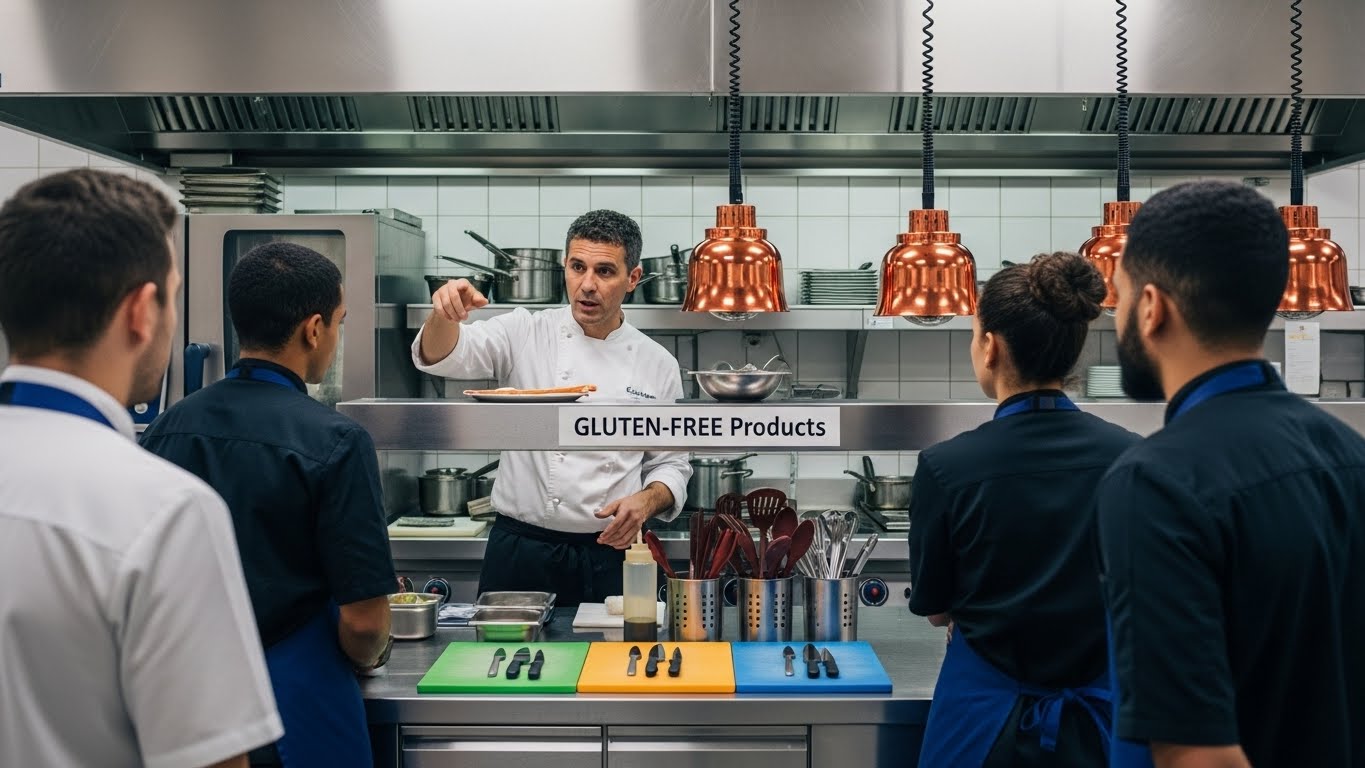
- Sharing utensils and surfaces: Ladles, tongs, cutting boards and countertops must be strictly separated. A cutting board used for traditional bread cannot be used for a gluten-free starter, even after “cleaning” it with a cloth.
- Underestimating volatile flour: Dusting a countertop with flour contaminates the kitchen air. Particles can settle on dishes intended for celiacs, making them unsafe.
- Use common ovens and toasters: Convection ovens can spread gluten particles. The toaster oven is one of the highest risk tools for contamination.
- Unwashed hands: A cook who handles bread or pasta with gluten and then, without washing his or her hands thoroughly, prepares a dish for a person with celiac disease transfers the contamination.
The mistakes not to make in the hall: The first line of trust
The wait staff is the calling card of your venue’s competence. One wrong or uncertain answer can destroy a customer’s confidence in seconds.
- Vague and improvised answers: Phrases such as “I think so” or “I’ll ask in the kitchen, but there shouldn’t be a problem” generate anxiety. Staff must be trained to give accurate and confident answers.
- Minimizing the problem: Saying “Let’s take the crouton off the plate and it’s fine” is a very serious mistake. The contamination has already happened.
- Lack of communication with the kitchen: An order for a customer with celiac disease must be signaled unequivocally, perhaps with a specific color or wording on the order, to activate safety protocol in the kitchen.
- Distracted service: Bringing a traditional bread basket to the table along with gluten-free dishes or mixing up the courses are mistakes that show a serious lack of attention.
The consequences of a superficial approach: Health and business risks
Ignoring the importance of proper management of celiac disease comes at a cost, both in human and economic terms.
The risks to the client
For a client with celiac disease, accidental ingestion of gluten can cause immediate symptoms such as abdominal cramps, nausea, vomiting, and dermatitis, ruining their evening and their health. In the long term, continuous exposure to gluten, even in small doses, increases the risk of serious complications. Offering a contaminated meal is not a simple “mishap,” but an act that puts a person’s health at risk.
The impact on your restaurant
From a business perspective, the consequences can be devastating:
- Negative reviews: A negative experience is almost always recounted online. A single review that mentions contamination or unprepared staff can turn away dozens of customers.
- Loss of trust and negative word of mouth: A customer who feels bad will never return. Not only that, he will recommend your establishment to his entire network of contacts. Remember that a customer with celiac disease often chooses the restaurant for an entire group of friends or family members.
- Image damage: An establishment perceived as unreliable and unprofessional loses credibility in the eyes of all customers, not just those with celiac disease. Attention to food safety is a value recognized by all.
- Loss of earnings: Losing the “gluten-free” market segment means giving up an important segment of loyal customers willing to spend.
Building competence: How to structure effective training on celiac disease
The good news is that becoming a benchmark for gluten-free is an achievable goal through structured training. Here are the pillars on which to base your team’s training.
- Grounded Theory:
- Explain in a simple way what celiac disease is and why contamination is dangerous.
- Define gluten and foods that contain it (“hidden” included, as in some sauces or industrial preparations).
- Illustrate naturally gluten-free foods.
- Clear Procedures for the Kitchen (Operational Checklist):
- Dedicated area: If possible, create a separate “Gluten-Free” area. Otherwise, define a protocol for complete sanitization of the station before each preparation.
- Exclusive equipment: Use cutting boards, ladles, pots and knives of a specific color (e.g., purple) only for gluten-free preparations.
- Safe storage: Store gluten-free raw materials (such as Magnatera pasta or our special flours) in airtight containers and on shelves placed above those with gluten, to prevent dust from falling, but even better if placed in a completely separate and dedicated location.
- Cooking protocol: Dedicated pots and water for pasta, clean oil for frying, separate or thoroughly cleaned cooking surfaces.
- Clear Procedures for the Room (Service Checklist):
- Hospitality and dialogue: Teach staff to always discreetly ask if there are allergies or intolerances.
- Menu knowledge: Waiters need to know exactly which dishes are safe, which can be adapted, and which are absolutely to be avoided.
- Order management: The wording “CELIACO” must be clear and visible to alert the kitchen.
- Table service: Gluten-free dishes should be brought in separately, perhaps by a dedicated waiter or with a recognition sign (e.g., a flag) to avoid mix-ups.
Frequently asked questions about managing celiac disease in restaurants
What exactly should a waiter say to a customer with celiac disease?
A trained waiter should say, “Sure, we have a dedicated menu/safe options for celiacs. Preparations are handled in the kitchen following a specific protocol to avoid cross-contamination. Let me know what you would like, I will be happy to assist you.” The key is to convey safety and competence.
Is it enough to use gluten-free ingredients to make a safe dish?
No, it is not enough. As we have seen, the use of certified gluten-free ingredients is only the first step. Without strict procedures to prevent cross-contamination in the kitchen, the final dish cannot be considered safe for a celiac.
Is there an official certification for gluten-free restaurants?
Yes, the most recognized route in Italy is to join the AIC’s Nutrition Outside the Home project. This includes a training process, an inspection to verify procedures and periodic checks. Being part of this network is a guarantee of reliability for customers with celiac disease.
From risk to opportunity: Gluten Free as an extraordinary marketing lever
A restaurant that seriously invests in celiac disease training is not simply solving a problem, but is creating a powerful competitive advantage.
- The “Veto” Factor: Often, in groups of friends or family, it is the person with dietary needs who decides where they go to eat. If your establishment is a safe choice for a celiac, you will have won not one customer, but an entire table.
- Loyalty and Word of mouth: A celiac customer who has a positive experience, feeling safe and pampered, will become your biggest supporter. He or she will talk about you, review you positively and return often, because finding a place of trust is priceless.
- Brand Reputation: Actively communicating your commitment to safe service (on the website, on social media, on the menu) positions your establishment as attentive, modern, and professional. This perception of quality extends to everything you offer, attracting even non-celiac but quality-conscious and detail-oriented customers.
The next step: make your venue a safe and sought-after destination
We have come to the end of this journey. It is now clear that in the restaurant market, celiac disease management is no longer an insignificant detail. It is the beating heart of a service that focuses on the customer, his safety and satisfaction. To ignore it is to fall behind, while to address it seriously opens the door to a growing, fair and profitable market.
Investing in the training of your staff means investing in the future of your restaurant, transforming it from a simple venue to a sought-after and reliable destination.
Commitment to safety and quality begins with training and continues in the selection of raw materials. When you are ready to offer your customers a gluten-free experience that is not only safe, but also extraordinarily tasty and authentic, discover Magnatera pasta. Made with all-natural ingredients and no additives, it provides a cooking hold and flavor that won’t make you regret traditional pasta.
Visit magnatera.com to explore our catering range and discover why top professionals choose us to bring Made in Italy excellence to their gluten-free dishes.