Gluten Free Safe?
The Definitive Guide to Labeling, Transparency and Food Safety.
Have you ever stood in the aisle of a supermarket, holding a package of pasta, scrutinizing a label that appears to be written in another language? You are not alone. In a world where food choices are increasingly conscious, transparency is no longer an optional extra, but a demand. And when it comes to “gluten-free,” this demand becomes an absolute necessity. Trust is the main ingredient, and the lack of it can have real health consequences.
For those experiencing celiac disease or a gluten sensitivity, food safety is a constant thought. Every label is an interrogation: is this “gluten-free” really free of contamination? Where do the raw materials come from? Are there pesticides? And what certifications really matter?
In this comprehensive guide, we will shed light on the jungle offood labeling, revealing all the secrets to shopping not only safely, but also consciously and with quality. You will learn how to recognize products you can trust, turning every meal into a moment of pure pleasure, without anxiety. Because eating well starts with an honest label.
The Anatomy of a Reliable “Gluten-Free” Label.
The wording “gluten-free” is the first beacon that guides choice, but by itself it is not enough. For real food safety, we need to look further and understand what lies behind that simple phrase. The difference between a safe product and a risky one is often written in small print.
What Does “Gluten Free” Legally Mean? The 20 ppm threshold
European law is very clear that a product can only be labeled “gluten-free” if the residual gluten content is less than 20 parts per million (ppm). This limit is considered scientifically safe for the vast majority of people with celiac disease.
But how does a consumer know that limit is met? It is not enough that the ingredients are naturally gluten-free. The real invisible enemy is cross-contamination.
The Hidden Danger: How to Avoid Cross Contamination.
Cross-contamination can occur at any stage of the supply chain:
- In fields: If a corn or rice field is next to a wheat field.
- In storage: If bags of flour with and without gluten are stored in the same warehouse.
- In production: If the same production line is used for traditional pasta and gluten-free pasta, without proper and certified sanitization.
- In packaging: Even wheat flour dust in the air can contaminate a product.
A serious manufacturer who puts consumer safety first invests in facilities dedicated exclusively to gluten-free. This eliminates the risk of contamination at the root, offering a guarantee that goes far beyond the simple list of ingredients. It is a structural choice that speaks of commitment and respect.
Deciphering the Symbols: A Guide to Certifications that Matter
Certifications are the identity card of a food product. They are seals of assurance issued by third-party, independent bodies that verify compliance with strict standards. Let’s learn to recognize the most important ones for informed choice.
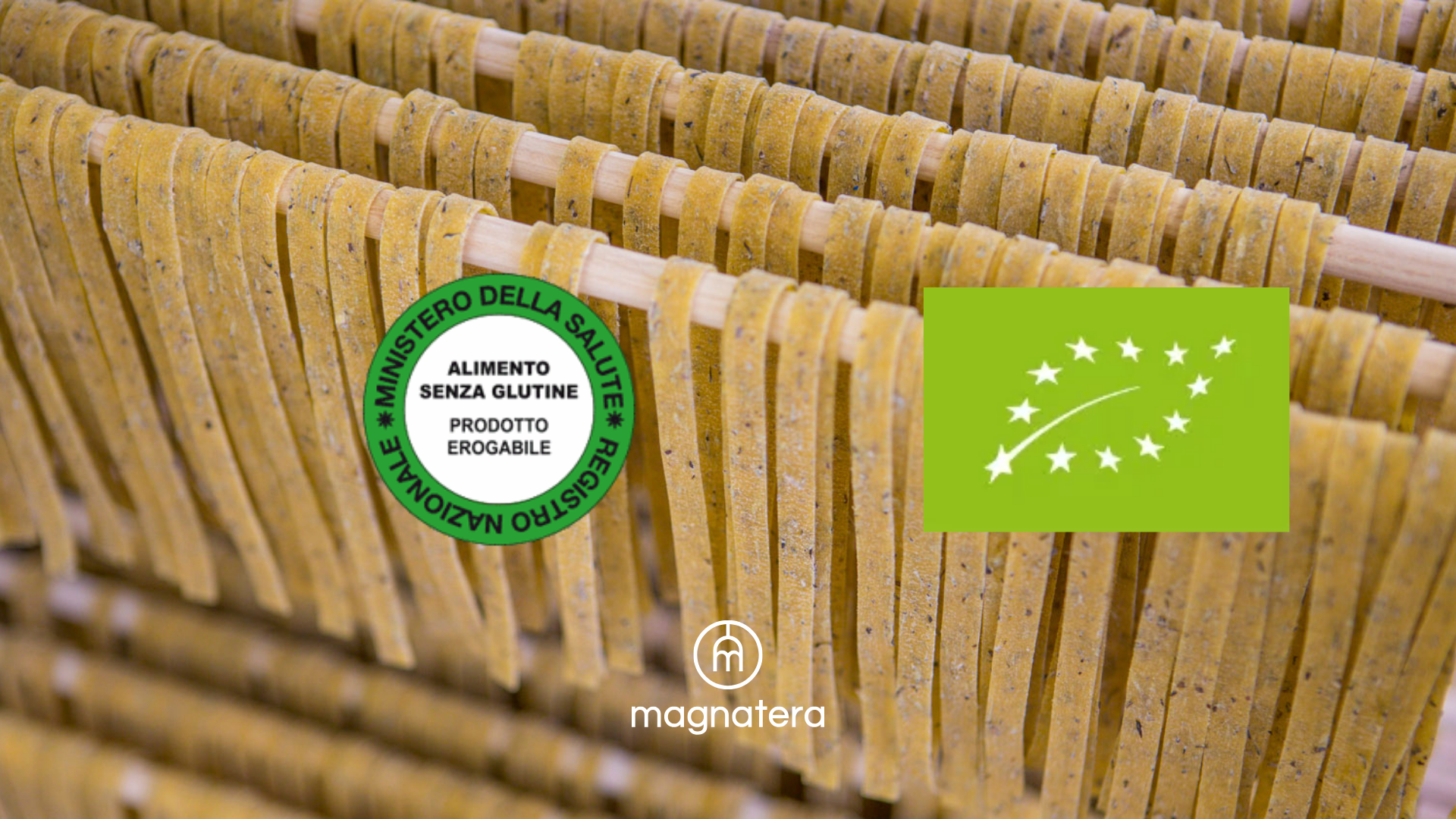
The Ministerial Stamp: The Passport to Celiac Safety.
if you have celiac disease and want to be on the safe side, the ministerial seal is the first filter to check. After that, you can look at additional certifications from associations (AIC, organic, etc.), but no private certification replaces the ministerial one.
It is the official certification of the Italian state: it indicates that the food complies with Italian standards for gluten-free products (Ministerial Decree 19/03/2008 as amended). It is not a “commercial stamp” or from a private association: it is a guarantee that the product complies with the Italian law on celiac disease.
Guarantees safe maximum gluten threshold: products certified with this label contain less than 20 ppm (parts per million) of gluten, which is the threshold considered safe for most celiacs.
It is mandatory to sell pasta and gluten-free products in Italy: if a product wants to be sold as “gluten-free” in Italy, it must have this stamp or the equivalent wording according to the law.
It protects you legally: in case of adverse reactions, the sticker shows that the manufacturer has complied with the rules. Without it, even if the product looks “gluten-free,” you have no legal or scientific guarantee.
Beyond Gluten: Certifications for a Healthy and Sustainable Choice
Food transparency today goes beyond gluten-free. Discerning consumers are also looking for other guarantees.
- Organic Certification (Euro-leaf Logo): The EU green leaf guarantees that the raw materials have been grown without the use of pesticides, herbicides and synthetic chemical fertilizers, and that the product does not contain GMOs. This is a vital guarantee for those seeking truly natural and clean food. If you want to learn more, European food safety regulations can be found on the portal of theEFSA (European Food Safety Authority).
- Vegan Certification: Marks such as VeganOK attest that no ingredients or processing aids of animal origin were used in the production process. An important reassurance for a growing segment of consumers.
Looking for products that accumulate these certifications means choosing companies that take a holistic approach to quality, caring not only for the end consumer but also for the environment.
Origin Counts: The Importance of Traceability and the “Clean Label”
Knowing what we eat also means knowing where it comes from. Traceability and clarity of ingredients are two key pillars of food transparency in 2025.
The Importance of Short Supply Chain and Made in Italy.
Choosing a 100% Made in Italy product is not just a matter of patriotism. It means relying on a supply chain regulated by some of the strictest food safety and quality control regulations in the world.
A company that prefers Italian raw materials often works directly with farmers, ensuring greater control over the quality of the harvest and the absence of undesirable substances such as pesticides. This proximity reduces intermediate steps, increasing the transparency and freshness of the final product. Asking “where does this corn come from?” is a legitimate question, and a transparent company is proud to answer it.
The “Clean Label” Philosophy: Few Ingredients, Highest Quality
Have you ever read an ingredient list as long as a novel? It often hides additives, emulsifiers, added sugars or artificial flavorings used to mask low-quality raw materials.
The “Clean Label” philosophy is the exact opposite. It is based on a simple principle: use fewer ingredients, but ones that are natural, recognizable and of the highest quality. Good gluten-free pasta needs nothing more than good flours (corn, rice, buckwheat, legumes) and water.
A clean label is a sign of an honest product that has nothing to hide and relies its taste solely on the excellence of its raw materials. To better understand the benefits of certain flours, you might read our in-depth discussion in this article.
Your Frequently Asked Questions (FAQs) on Security and Transparency
Listening to consumers’ concerns, we have gathered the most common questions to provide clarity once and for all. Here are the answers you’ve been looking for, phrased simply and directly, as if you were asking them of your voice assistant.
- “Is it enough for a product to have no gluten in its ingredients to be safe?”
No, absolutely not. A rice flour product can be contaminated if it is processed in a plant that also produces wheat pasta. True safety comes from certification (such as the Barred Ear) and the guarantee of production in a protected and dedicated environment. - “How can I be sure of the origin of raw materials and the absence of pesticides?”
Look for Organic certification (the EU leaf-shaped logo). Feel free to inquire about the company’s production process, as we explain on our page . - “If the label says ‘may contain traces of gluten,’ can I eat it?”
If you have celiac disease, the answer is no. That wording is a warning that the manufacturer puts in to protect itself, and it indicates a real risk of contamination. A product that is truly safe for celiacs will never have that phrase. - “Why do some gluten-free pastas flake in cooking and others do not?”
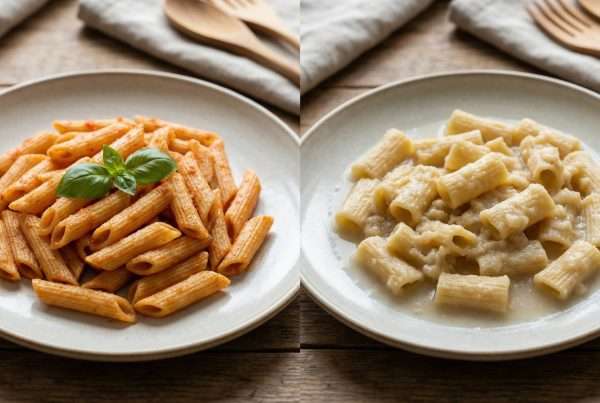
Holding in cooking depends on the quality of the raw materials and the production process (drawing and drying). The best pastas, such as bronze-drawn and slowly dried at low temperature, maintain a perfect texture and rich taste, fully comparable to traditional pasta. Quality makes all the difference.
The Magnatera Commitment: Where Transparency and Taste Meet
We talked about labeling, certification and food safety. For us at Magnatera, these are not just marketing concepts, but the pillars on which we have built our family business.
Our commitment to total transparency is translated into concrete actions:
- Dedicated Production: Our pasta factory in Veneto is 100% gluten-free. No risk of contamination. Your safety is our priority.
- Multiple Certifications: All our pasta is certified Gluten Free with the AIC’s Barred Ear, and many of our references are also Organic.
- Clean Label (“Clean Label”): We use only natural and fine raw materials–non-GMO flours, spring water and, in some recipes, real ingredients such as spices, herbs or seaweed. No additives, dyes or added sugar. Never.
- Controlled Origin: We favor Italian raw materials and trace every single batch, from the field to your plate. For us, the label “100% Made in Italy” is a promise kept.
- Authentic Taste: We believe that “gluten-free” should never mean “tasteless.” Our pasta is beloved by celiacs, health-conscious people, and foodies because it is simply good, with a hold in cooking that never disappoints.
Choosing Magnatera means choosing a product that respects your health, your palate, and your need for trust.
Your Choice Makes a Difference
Navigating the world of gluten-free doesn’t have to be an obstacle course. You now have all the tools you need to read a label with new, informed eyes.
Remember the key points: look for the Ministerial Seal, prefer organic, check the origin of raw materials, and trust short and simple ingredient lists.
Your choice at the supermarket is a vote. By voting for transparency, you reward companies that invest in quality and honesty, and you help create a better and safer food market for all. Eating gluten-free is not giving up, but an opportunity to discover a world of new, wholesome and incredibly tasty flavors.
Are you ready to taste the difference that true transparency can make?
Explore the full range of Magnatera pasta on our website and discover why our passion for quality is felt with every forkful.
Visit magnatera.com now and bring the authentic taste of safety to the table