The Value of Craftsmanship: Why Choose a Gluten-Free Pasta Produced by Traditional Method
Picture this scene: you have guests for dinner, including a friend with celiac disease.
You want to make a pasta dish that will win everyone over, without compromise. You open the pantry and pull out that packet of gluten-free pasta bought in a hurry at the supermarket.
The result? A pasta that falls apart in cooking, with an anonymous flavor and sticky texture. A disappointment that deadens even the most delicious sauce.
This experience, unfortunately, is all too common. But it doesn’t have to be. There is a universe of difference between gluten-free pasta produced on an industrial scale and that born of passion and craftsmanship. Choosing a superior quality pasta is not a luxury, but an affirmation of taste, well-being, and respect for food. In this article, we will explore together the value of craftsmanship in the world of gluten-free pasta and guide you to understand why choosing a traditionally made product, such as Magnatera pasta, turns a simple meal into an unforgettable gourmet experience.
Gluten-Free Pasta: the Gap between Industrial Shelf and Artisan Laboratory
When we walk through the aisles of a large supermarket, we are bombarded with offers, colorful packaging and bargain prices. Industrial logic, also applied to the gluten-free sector, has only one goal: maximize production and minimize costs. This approach, inevitably, leads to compromises on quality.
Industrial pasta is often the result of an accelerated process:
- Ultra-refined flours: Standardized blends are used, often poor in nutrients and flavor, chosen more for their economic yield than for their organoleptic properties.
- Additives and shortcuts: To compensate for the lack of gluten and to achieve an acceptable consistency quickly, emulsifiers, thickeners and stabilizers are added.
- High-speed processes: Teflon drawing and drying at very high temperatures (over 100°C) for a few hours “cooks” the pasta before it even reaches your pot, denaturing proteins and vitamins.
In contrast, an artisanal pasta maker like our Pastificio Pangea, creator of Magnatera, embraces an opposite philosophy. The goal is not to produce more, but to produce better. Choosing a gluten-free pasta made with traditional methods means preferring a product that comes from care, time and a deep knowledge of raw materials. It is a choice that can be seen, felt to the touch and, above all, tasted on the plate.
The Secrets of the Traditional Method Applied to Gluten-Free
Creating gluten-free pasta that holds its cooking, is rough just right, and has authentic flavor is a true art. It requires not only technique, but also a passion that big industry cannot replicate. Let’s see what are the pillars of artisan production that make the difference.
The Selection of Raw Materials: Not All Flour is the Same
The starting point of every great dish is an outstanding ingredient. For pasta, that ingredient is flour. While the industry relies on basic blends of corn and rice, an artisan explores a world of possibilities to create a unique product.
At Magnatera, our research is relentless. We select only 100% Italian, natural, non-GMO and, where possible, organically grown raw materials. This allows us to create innovative and balanced recipes, such as:
- Pasta with legume flours (red lentils, peas): Rich in protein and fiber, with a strong and satisfying taste, perfect for those on a vegan or vegetarian diet. You can find great ideas on how to use it in our blog (links to recipes with our legume pasta).
- Pasta with Buckwheat: Rustic in flavor and rich in antioxidants, a tribute to mountain traditions.
- Pasta with Quinoa and Seaweed: A bold mix that brings a superfood rich in essential amino acids and a touch of marine flavor to the plate.
This attention to raw material is not only a matter of taste, but also of nutritional value. A quality flour, not impoverished by industrial processes, retains its beneficial properties intact.
Bronze Drawing: the Secret to a Surface that Embraces the Sauce
Have you ever noticed that some pastas seem “slippery” and don’t bond with the seasoning? Often, Teflon drawing, a smooth mold that the industry uses to produce faster and reduce tool wear, is to blame.
The artisanal method, on the other hand, prefers bronze drawing. This ancient process involves extruding the dough through bronze dies. The porous surface of this metal creates micro-scratches on the surface of the dough, making it rough and opaque. Why is it so important?
- Porosity: The rough surface literally “clings” to the sauce, holding it in and creating a perfect amalgam between pasta and sauce. Every forkful is an explosion of flavor.
- Consistency: Bronze-drawn pasta has a fuller texture that is satisfying to the palate, much more similar to that of the best traditional semolina pasta.
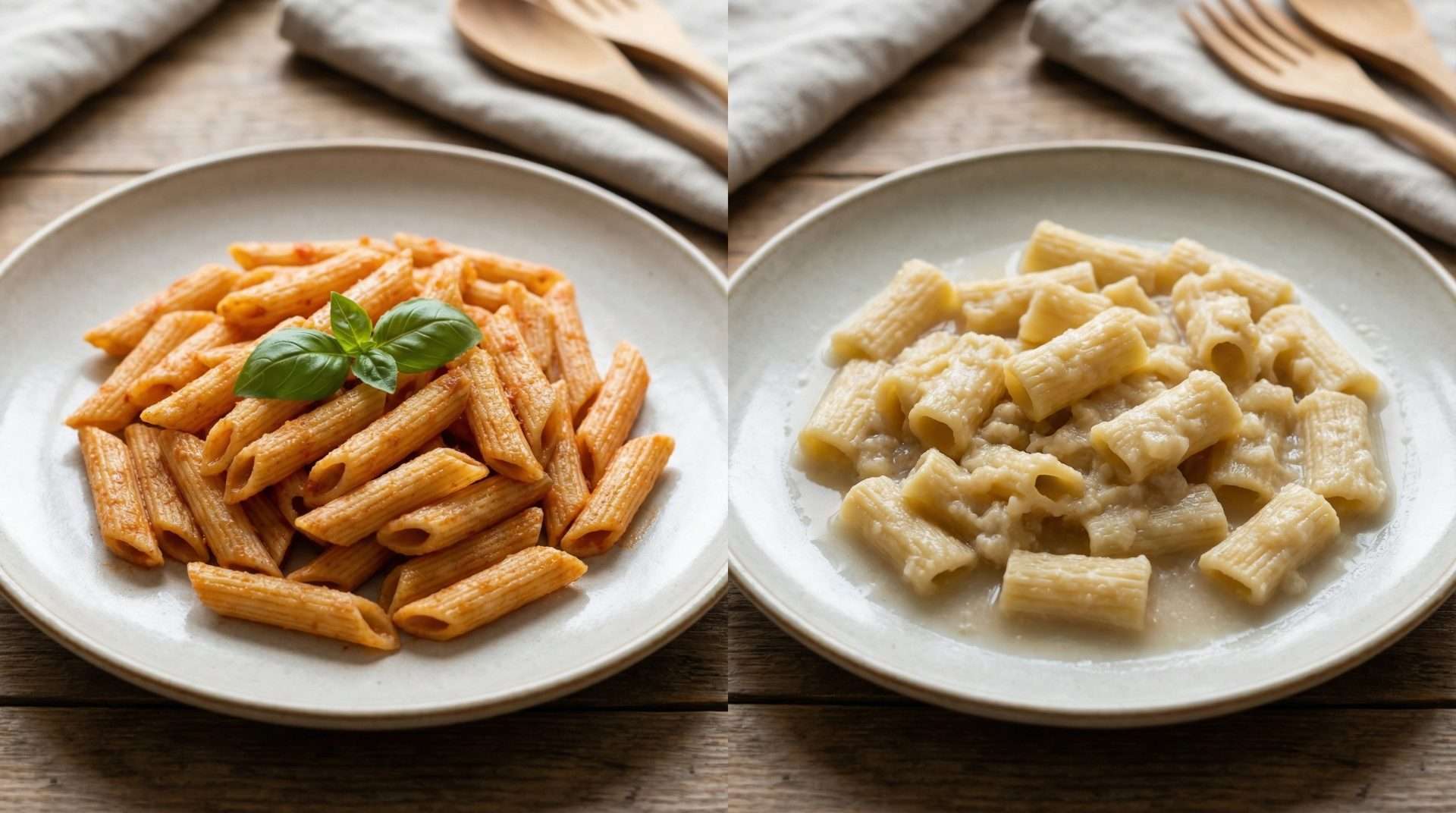
- Visual quality: Recognize a bronze-drawn pasta by its paler, dusty appearance, an unmistakable sign of superior quality.
Slow Drying at Low Temperature: Time as an Ingredient
This is perhaps the most important and least known secret. To reduce production time, the industry dries the dough in a few hours at temperatures that can exceed 100°C. This violent process causes a heat shock that “vitrifies” the starch, damages nutritional properties and compromises flavor.
A true craftsman knows that time is a valuable ingredient. At Magnatera, we practiceslow, low-temperature drying (below 50°C), which can take up to 20 hours depending on the format. This gentle and patient method offers tremendous advantages:
- Preserves nutrients: Vitamins, minerals and proteins in flours are not altered by excessive heat.
- Enhances flavor: Keeps the authentic aroma of raw materials intact, without that “cooked” aftertaste typical of industrial pastas.
- Ensures tightness during cooking: The pasta rehydrates evenly during cooking, remaining elastic and always “al dente,” without flaking.
Choosing a slowly dried pasta means bringing to the table a food that is not only tastier, but also healthier and more digestible. To learn more about the impact of production processes, you can consult authoritative sources in the field of food science.
“Clean Label: The Importance of What’s NOT in Your Pasta.
In an increasingly health-conscious market, the concept of a “clean label” is becoming a crucial choice factor. A clean label means a short, clear and understandable ingredient list, free of complex chemical terms and artificial additives. Trends for 2025 confirm a growing demand for genuine and transparent products.
Industrial gluten-free pasta, to mask less-than-excellent raw materials and hasty processes, often resorts to:
- Emulsifiers (e.g., mono- and diglycerides of fatty acids): These are used to bind the dough and make it more workable, a chemical shortcut to mimic the function of gluten.
- Thickeners and gums (e.g., xanthan gum): Added to improve consistency and prevent the paste from becoming sticky.
- Added sugars and coloring agents: Used to improve flavor and appearance of an otherwise drab product.
Magnatera’s craft philosophy is the exact opposite.
We believe that outstanding pasta needs no tricks. Our ingredients are only two or three: water and the best natural flours. No additives, no added sugars, no dyes. Ours is a promise of purity that you can read clearly on the label and taste in every dish, a guarantee of safety even for the most demanding consumers, such as people with celiac disease, who need absolute certainty, as theItalian Celiac Association (AIC) points out.
Frequently Asked Questions about Gluten-Free Pasta Craftsmanship.
Here we answer some of the most common questions we receive to help you make an even more informed choice.
Why does homemade gluten-free pasta cost more?
The price reflects the real value of the product. Higher costs are due to: selected raw materials (organic, non-GMO, special flours), much longer processing times (slow drying takes days, not hours), the use of traditional machinery such as bronze dies, and small batch production, which ensures meticulous quality control. It is an investment in quality, flavor, and your health.
How can I recognize a true gluten-free artisan pasta?
Look carefully at the pasta before you buy it. Look for these signs: an opaque color and a porous, almost “dusty” surface (a symptom of bronze-drawing), a color that is not perfectly uniform (a sign of natural raw materials), and, most importantly, read the label. A very short ingredient list, with no emulsifiers or thickeners, and the words “slowly dried at low temperature” are the best guarantees.
Does homemade gluten-free pasta cook differently?
Yes, and for the better! Thanks to the quality of the dough and the slow drying process, it has an extraordinary hold during cooking. It releases just the right amount of starch, creating a delicious creamy texture that binds the sauce and stays perfectly “al dente.” Our advice is to follow the timing on the package and taste it a minute beforehand to achieve the consistency you prefer.
Can gluten-free pasta really taste like traditional pasta?
Absolutely. This is the goal of every true artisan. Using high-quality flours and respectful processes, an artisanal gluten-free pasta can not only match, but often surpass in complexity and richness of flavor many traditional pastas. It’s a matter of approach: it’s not about “taking out the gluten,” it’s about “creating excellence with alternative ingredients.” Discover the story of our passion at.
Conclusion: the Craft Choice is a Choice of Value
Choosing gluten-free pasta no longer means settling for it. It means opening the door to a world of flavors, textures and nutritional possibilities that mass industry cannot offer. The value of craftsmanship lies not only in the finished product, but in the entire philosophy that surrounds it: respect for the earth, the meticulous selection of ingredients, the patience of slow processes, and the passion of skilled hands that transform simple flours into masterpieces of taste.
When you choose a pasta like Magnatera, you are not just buying food. You are embracing a Made in Italy tradition, you are rewarding quality and transparency, and you are bringing to your table a food that is genuine, healthy and incredibly good. It is a choice that nourishes the body and satisfies the spirit, dedicated to those who want no compromise.
Don’t settle. Discover the true taste of high-quality gluten-free pasta, created with the care and passion that only a traditional method can guarantee.
Visit the shop at magnatera.com and bring the excellence of Italian craftsmanship to the table.