Artisan vs. industrial gluten-free pasta: The differences you need to know to choose quality.
Have you ever stood in front of the supermarket shelf, overwhelmed by dozens of packages of gluten-free pasta, and felt confused? On the one hand, the eye-catching offerings of the big brands; on the other, the more niche offerings, often referred to as “artisanal.” The price is different, the packaging too, but the real question is: what really changes? The answer is: everything. Understanding the most important differences between artisanal and industrial gluten-free pasta is not just a matter of taste, but a conscious choice for your health and well-being.
On this journey to discover true quality, we will guide you step by step. We will reveal the secrets behind a production process, the choice of raw materials and the impact these elements have on the final product you bring to the table. Get ready to become a more informed consumer and to stop settling for just any gluten-free pasta, because you deserve an authentic and genuine taste experience, just like that offered by a traditional pasta.
The heart of the difference starts with the ingredients
The first, fundamental distinction between an artisanal and an industrial product lies in the list of ingredients. This is where the most important game is played for the quality and wholesomeness of the product.
Artisanal simplicity: water and noble flours
A true artisanal gluten-free pasta, like Magnatera’s, bases its excellence on a clean and transparent recipe. Ingredients are few and of the highest quality:
- Selected flours: Only naturally gluten-free, non-GMO and often organically grown flours are used. We are talking about corn, brown rice, buckwheat, quinoa, legumes such as lentils, peas and chickpeas, and flax flour. Each flour is chosen for its nutritional properties, and for the character and flavor it imparts to the pasta.
- Pure water: The other element is simply water, from local and controlled sources, which enhances the characteristics of the flours without altering them.
- No hidden “extras”: You will never find additives, emulsifiers, added sugars, coloring agents or artificial flavors in a high-end artisan pasta. The philosophy is simple: the quality of the raw material, and the expertise in processing, needs no chemical shortcuts. This approach, known as “clean label,” is a guarantee for those seeking truly natural food.
This rigorous choice results in a product that is not only “gluten-free,” but is nutritious, digestible, and rich in taste.
Industrial complexity: additives and emulsifiers
Industrial gluten-free pasta, especially first-priced pasta, has primarily the need to maximize yield and standardize the product on a very large scale. This almost always leads to the use of additional ingredients that serve to “correct” or facilitate rapid production processes.
Scrolling down the label, you might find:
- Mono- and diglycerides of fatty acids (E471): These emulsifiers are added to improve the “workability” of the dough and to prevent the dough from sticking or splitting during less-than-perfect baking. In practice, they serve to mask the limitations of a process and of less-than-excellent raw materials.
- Gums (Guar, Xanthan): Used as thickeners and stabilizers to give structure to a dough that would otherwise be brittle, especially when using very refined and fiber-poor flours.
- Deglutinated flours or starches: Often the base is starch blends (such as cornstarch) rather than whole grain flours because they are cheaper and easier to process. The result is a nutritionally poorer product with a neutral, almost nonexistent flavor.
The presence of these elements is a clear indicator of an industrial approach, where the goal is standardization at the expense of naturalness.
The process makes dough: Processing and Timing
If the ingredients are the soul of the pasta, the manufacturing process is its body. The differences in processing between artisanal and industrial gluten-free pasta are abysmal and crucially determine the texture, hold during cooking, and ability to bind with the sauce.
Bronze wire drawing: the surface that loves sauce
Have you ever noticed that some pastas are smooth and straw yellow, while others have a paler appearance and a rough, almost porous surface? This difference is due to the drawing process.
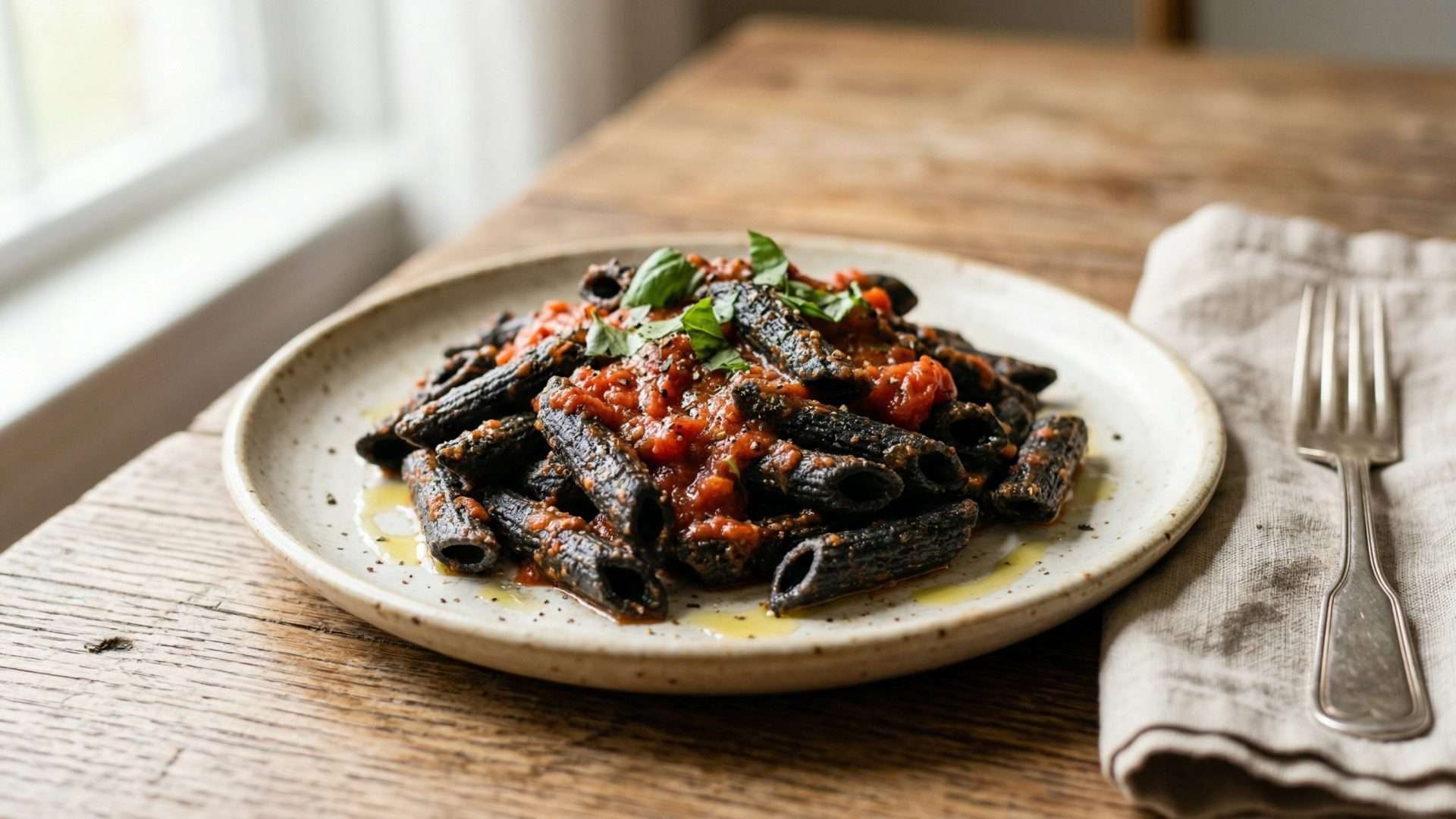
Quality artisanal pasta, like Magnatera’s, is almost always bronze drawn. The dies are the molds from which the dough takes shape (penne, fusilli, spaghetti, etc.). Bronze ones, unlike modern Teflon ones used in industry, “scratch” the surface of the dough, making it porous and opaque. This is not a defect, but its greatest asset: a rough surface is able to capture and hold all kinds of sauces, creating a perfectly blended and flavorful dish.
In contrast, Teflon drawing, which is faster and more wear-resistant, produces a smooth, shiny paste on which the sauce tends to “slide” off, ending up at the bottom of the dish.
Slow drying at low temperature: The Secret of taste and tightness
Here is another crucial secret. The drying process is critical to the final quality.
- Artisan Method: The dough is dried, in static dryers, very slowly (12 to 36 hours, depending on the size) at very low temperatures (never above 40-50 °C) simulating the drying that used to take place in the sun in ancient times. This gentle process makes it possible to preserve all the organoleptic and nutritional properties of the raw materials. The result is a pasta that during cooking releases the authentic fragrance of the flours used (corn, rice, buckwheat) and maintains an extraordinary hold, always remaining “al dente.”
- Industrial Method: To speed up time and increase production volumes, the industry uses drying processes in continuous high-temperature (up to 90-100 °C) and very rapid (a few hours, sometimes less than 3) dryers. This heat shock “vitrifies” the starch, making the pasta more yellow and seemingly sturdy, but in fact compromises its nutritional value, flattens its flavor, and worsens its hold during cooking. It is the reason why many industrial gluten-free pastas go from “raw” to “uncooked” in an instant, without a real “al dente” phase and are almost always sticky.
The ‘experience at the table: taste, tightness and nutritional value
Having emphasized the nutritional differences, another thing that matters is the result on the plate. The differences we have discussed result in a completely different taste experience.
Why Does Artisanal Pasta Hold the Cooking Better?
The combination of quality flours, no additives and, most importantly, slow drying, gives artisanal pasta a more balanced protein and starch structure. This means that it absorbs water more gradually and evenly during cooking, ensuring an exceptional hold. No longer will you have to fear the “panic moment” when the pasta comes apart in the pot. You can finally trust the cooking time and get a perfect result even if the recipe calls for baking or final tossing.
While many industrial pastas taste neutral and anonymous, serving only as a vehicle for the sauce, artisanal pasta takes center stage. If you taste a Magnatera ” Active Harmonies” noodle, you will smell fresh and peppery aroma, taste and aftertaste that would not even need the sauce!
If you try “Le Classiche” organic corn and rice fusilli, you will sense their delicate sweetness. This is the magic of excellent raw materials and respectful processing: the pasta has a flavor of its own, enriching the dish instead of merely acting as a background.
Not only Gluten Free, but Rich in Nutrients
A gentle production process not only preserves taste but also nutrients. The vitamins, minerals and fiber found in source flours (especially if whole grain or legume flours) are preserved in low-temperature drying, unlike high industrial temperatures. Choosing artisanal therefore means not only eliminating gluten, but adding nutritional value to one’s diet. It is a choice that finds full support from the latest guidelines for healthy eating, as also indicated by authoritative sources such as the Italian Celiac Association and the Ministry of Health.
How to recognize true artisan gluten-free pasta
Now that you know the theory, here’s a practical guide to becoming an expert quality hunter on the shelf:
- Read the label: It is your product ID card. Look for a short, clean ingredient list. If you see acronyms like “E471” or words like “mono and diglycerides,” “guar gum,” you are almost certainly looking at an industrial product. Check for statements such as “No additives” to be sure you have an artisanal product on your hands; usually companies that don’t use them are very keen to make it public.
- Look for the magic words: “Bronze-drawn” and “Slowly dried at low temperature” are almost always synonymous with artisanal quality. A producer who is proud of his method will proudly communicate this on the package.
- Observe the dough: Even with the naked eye you can see differences. Artisan dough has a more natural and less uniform color than industrial dough. Its surface, as mentioned, is visibly rougher and duller.
- Consider the price: An artisanal pasta will inevitably cost more. This price is not an unjustified mark-up, but a reflection of the cost of superior raw materials (organic, non-GMO), a process that requires much more time, waste and energy(slow drying) and more careful handwork. It is an investment in your health and enjoyment at the table. Tomorrow’s health depends on the choices we make today.
Frequently Asked Questions: The Answers You Seek
We have collected some of the most common questions about artisanal gluten-free pasta to clear up any doubts.
Why does gluten-free artisanal pasta cost more?
It costs more because it is made with better ingredients (organic and selected flours), with a much longer process that involves more waste(slow drying takes up to 36 hours versus 3-4 industrial) and packaged by hand with a care that mass production cannot guarantee. It is the price of quality, health and taste.
Is homemade gluten-free pasta more digestible?
Yes, for two reasons. First, the absence of chemical additives avoids burdening the digestive system. Second, the use of whole or semi-wheat flours and slow drying preserves a more natural and less “stressed” texture, which our bodies process more easily.
Is all artisanal pasta also organic?
Not necessarily, but the two concepts often overlap. Artisan brands like Magnatera, which strive for excellence, almost always choose raw materials from organic farming to ensure a clean and sustainable product from A to Z.
How best to cook gluten-free artisanal pasta?
Use plenty of salted water (at least 1 liter per 100g of pasta) and strictly adhere to the cooking time indicated on the package. Because it holds together so well, you can also drain it a minute earlier and finish cooking it directly in the pan with the sauce. For ideas and inspiration, discover recipes in our blog and Instragram profile @pasta_magnatera.
The choice is yours: don’t settle
Now you know the substantial differences between an artisanal gluten-free pasta and an industrial one. These are not just nuances, but two completely different worlds: one based on quality, transparency and respect for raw materials; the other on speed, standardization, chemical compromise and profit maximization.
Choosing artisanal pasta means choosing healthier eating, more authentic taste and a finally fulfilling experience at the table. It means supporting companies, like the family-owned Pangea pasta factory, that put passion and Made in Italy excellence at the heart of every one of their creations.
Are you ready to feel the difference? Don’t just take our words at face value: put them to the test.
Explore Magnatera’s range of artisan gluten-free pasta at www.magnatera.com
Discover unique formats, innovative recipes and bring the true taste of Italian quality to the table. Your body and palate will thank you.