Gluten-free pasta: how to recognize the really healthy one (without additives and allergens)
The world of gluten-free pasta is an ever-expanding universe. Whereas until a few years ago finding a viable alternative to durum wheat pasta was a feat, today supermarket shelves are teeming with options. But this abundance hides a pitfall: not all “gluten-free” pasta is the same. Indeed, often behind a healthy appearance lie unhealthy ingredients, unnecessary additives and disappointing nutritional value. Therefore, the question every discerning consumer should ask is not just “where do I find gluten-free pasta?” but “how do I recognize the really healthy one without additives and allergens?”
We will take you on a discovery of the secrets hidden in labels. You will learn how to distinguish a high-quality product from a mediocre one, decipher the ingredient list and make an informed choice for you and your family. Because choosing gluten-free doesn’t have to mean giving up health, taste or Italian tradition.
The deception of the label: what’s really behind “gluten-free”
The first step in becoming a savvy consumer is to expose a common misconception: the equation “gluten-free = healthy.” Although essential for those with celiac disease or gluten sensitivity, the absence of this protein does not in itself guarantee that a product is healthy. Many companies, in an attempt to mimic the texture and hold in cooking of traditional pasta, resort to chemical shortcuts.
Not everything that is gluten-free is automatically healthy!
The so-called “health halo” leads many to perceive a food labeled “gluten-free” as inherently better, even when it is not. Often, to compensate for the absence of gluten (which acts as a “glue”), manufacturers use ultra-refined flours, modified starches, and, unfortunately, a host of additives that have little to do with natural, clean eating.
The result? A pasta that, while safe for a celiac, can be low in fiber, vitamins, and minerals, and high in artificial ingredients that a health-conscious consumer would prefer to avoid.
Additives and “hidden” ingredients: the enemies of clean pasta
When you read a gluten-free pasta label, pay attention to these “intruders.” If you find them, it’s a red flag about the quality of the product. Among the most common are:
- Mono and diglycerides of fatty acids (E471): These are emulsifiers used to improve the texture and stability of dough. Although considered safe, their presence indicates an industrial process away from naturalness. High-quality dough does not need them.
- Gums (Guar, Xanthan): They are added to bind the dough and improve elasticity. In small amounts they are not harmful, but their presence suggests that flours used alone are not performing well enough.
- Modified starches: These are starches that have been chemically or physically treated to alter their properties. They are used to improve hold during cooking, but they are a processed ingredient that adds no nutritional value.
- Added sugars (dextrose, glucose syrup): These are sometimes added to balance the flavor or improve the browning of the product. These are empty calories and completely unnecessary in a pasta that calls itself healthy.
A true healthy gluten-free pasta can be recognized by its simplicity.
Less is more: the golden rule of ingredient list
This is the most important rule. A short ingredient list is almost always synonymous with quality and naturalness. An excellent gluten-free pasta should simply contain:
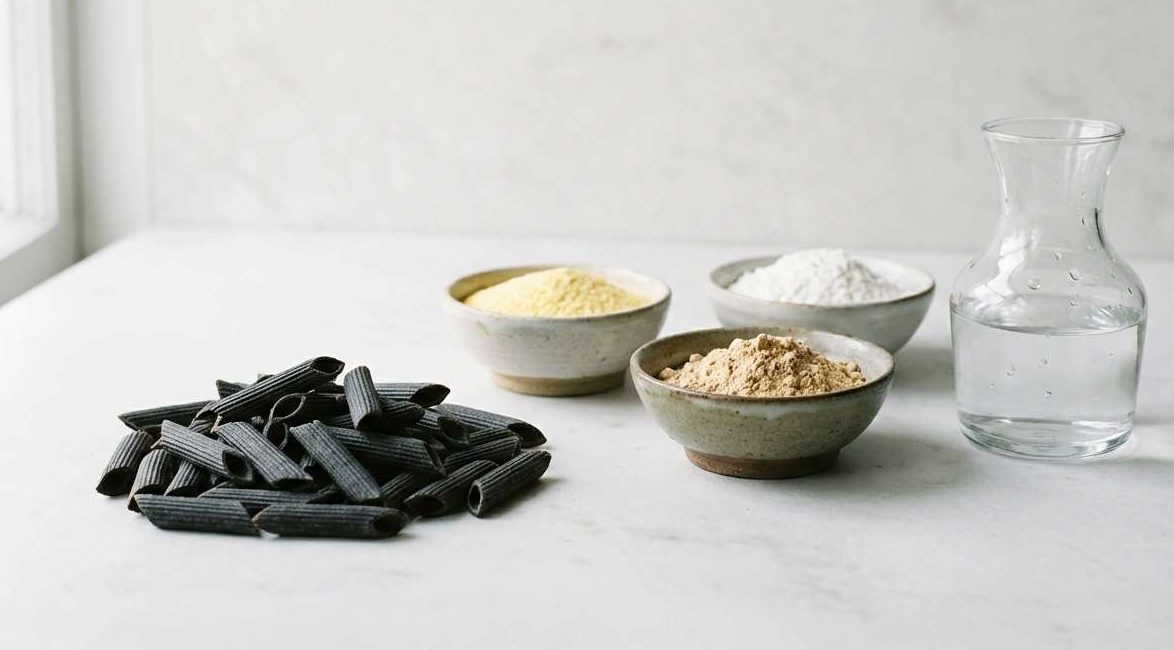
- Flour (or a flour mix)
- Water
Everything else is, in most cases, superfluous. If the list starts getting longer with emulsifiers, thickeners, flavorings or sugars, you are looking at a highly processed product. A pasta like Magnatera, for example, bases its excellence precisely on a very short ingredient list: only the best natural flours and water.
Deciphering flours: from classic corn and rice to nutritious alternatives
The quality of the dough depends entirely on the quality of the flours used. The most common combination is corn and rice, but even here there are substantial differences.
- Corn and Rice: Look for whole-grain or semi-wheat flours, which retain more fiber and nutrients. The words “corn flour” without other specifications often indicate a very refined flour. Prefer products that specify origin (e.g., 100 percent Italian) and the non-GMO nature of the raw materials.
- Buckwheat: Despite its name, it is not a grain. It is naturally gluten-free, rich in high biological value protein, fiber and antioxidants. It gives pasta a more rustic and assertive flavor.
- Legumes (lentils, chickpeas, peas): Legume pasta is a fantastic innovation. It is incredibly rich in plant protein and fiber, with a lower glycemic index. Perfect for athletes, vegans and anyone who wants a more complete and satiating meal.
- Quinoa, Amaranth, Teff: These pseudo-cereals are superfoods. They provide protein complete with all essential amino acids, minerals such as iron and magnesium, and a unique taste.
- Innovative Mixes: Cutting-edge manufacturers, such as Magnatera, are daring with mixes that include functional ingredients such as seaweed, herbs, or spices, turning a simple pasta dish into a taste and wellness experience.
Added sugars and allergens: utmost attention to transparency
In addition to additives, always check the nutrition table for the entry “of which sugars.” In a quality dry pasta, this value should be very low (usually less than 1g per 100g), representing only the sugars naturally present in the flours. If the value is higher, it is likely that sugars have been added.
Regarding allergens, the law requires them to be highlighted in bold. A quality gluten-free pasta should not contain allergens unless they are a voluntary ingredient (e.g., soybean pasta). Look for the words “produced in an establishment that also processes…” to understand the risk of cross-contamination if you have multiple allergies.
Warranty seals: how to recognize a safe and certified product
Words on the label are important, but official symbols offer extra assurance. Learn to recognize them to shop with total peace of mind.
The ministerial seal: your number one ally against gluten
For those with celiac disease, this symbol is essential. The “Bollino Ministeriale” logo, granted in Italy by the Ministry of Health, guarantees that the final product contains less than 20 ppm (parts per million) of gluten, a threshold considered safe internationally. It also ensures that the entire production process is controlled to avoid any risk of contamination.
The value of organic: why choose organic pasta
The European green leaf logo certifies that the raw materials have been grown without the use of pesticides, herbicides and synthetic chemical fertilizers. It also guarantees that the ingredients are non-GMO (Genetically Modified Organisms). Choosing organic gluten-free pasta means opting for a product that is cleaner, more environmentally friendly and often richer in flavor because it comes from a healthier land. To learn more about regulations, the European Commission ‘s website on organic farming is an excellent resource.
Beyond organic: the meaning of “Clean Label”
“Clean Label” is not a certification, but a concept that is becoming increasingly important to consumers. A “Clean Label” product is characterized by:
- A short and understandable ingredient list.
- The absence of chemical names, artificial additives, preservatives and dyes.
- The use of ingredients that are as natural and unprocessed as possible.
A brand like Magnatera perfectly embodies the “Clean Label” philosophy, offering a pasta whose label could be written by grandma: flour and water.
Healthy pasta does not mean tasteless: tightness in cooking and authentic flavor
One of the most die-hard misconceptions about gluten-free pasta is that it is uncooked, sticky, and tasteless. This was true for the first products brought to market, but today technology and craftsmanship have made great strides.
The secret of a pasta that doesn’t shake
Tightness in baking depends on three key factors:
- Quality flours: Balanced mixes of fine flours create a structure that holds up to heat.
- Bronze wire drawing: This traditional method creates a rough, porous surface, which not only holds the sauce better, but also contributes to a better final texture.
- Slow drying at low temperatures: This process, which can take up to more than 20 hours, preserves the nutritional and organoleptic properties of the raw materials and “fixes” the structure of the dough, making it tough and elastic to the bite.
When choosing your pasta, look for these directions on the package. They are the trademark of pasta makers who put quality first.
Authentic taste: when flour makes a difference
A high-quality gluten-free pasta does not try to imitate the flavor of wheat pasta, but proudly expresses the taste of its raw materials. A corn and rice pasta will have sweet and delicate notes, a buckwheat pasta will be more earthy and robust, while a red lentil pasta will impress with its distinctive, enveloping flavor.
Excellence lies in enhancing these flavors, not hiding them. That’s why exploring different types of gluten-free pasta can turn into a real gastronomic journey. Try pairing them with the right sauces to enhance their characteristics.
Frequently Asked Questions (FAQ) about Healthy Gluten Free Pasta
We answer some of the most common questions users ask of search engines and voice assistants.
What is the healthiest gluten-free pasta?
The healthiest pasta is one with a “clean” label: few ingredients (flour and water), preferably organically grown, with no additives, emulsifiers or added sugars. Pastas made with legumes or pseudo-grains such as buckwheat and quinoa offer a superior nutritional profile in terms of protein and fiber.
Is corn and rice-only pasta a good choice?
Yes, as long as it is of high quality. Look for products that use non-GMO flours, preferably whole or semi-wheat, and contain no additives. It is an excellent neutral base, but for a more nutritious meal you may want to alternate it with pastas made with other flours.
How can I be sure that a pasta does not contain hidden allergens?
Always read the ingredient list carefully, where allergens are highlighted by law. For maximum safety against gluten, look for the ministerial seal logo. If you have other allergies, check the words “may contain traces of…” to assess the risks of cross-contamination.
Can gluten-free pasta really taste the same as traditional pasta?
No, and that’s the beauty of it! A quality gluten-free pasta does not taste the same; it tastes different and authentic, linked to its raw materials. Its excellence lies in its hold in cooking and ability to bind with the sauce, offering a comparable al dente experience, but with a unique and delicious flavor personality.
What are emulsifiers such as E471 and why should I avoid them?
Emulsifiers such as mono- and diglycerides of fatty acids (E471) are additives used to make a dough more stable and homogeneous. Although legal, their presence indicates that the product needed chemical “help” to achieve the desired consistency. An artisan-made pasta made with high-quality flours has no need for them. Avoiding them means choosing a more natural and less processed product. And to be sure of their absence it is not enough that they do not appear among the ingredients, it is better if there is a clear indication “WITHOUT ADDITIVES” on the package.
Your conscious choice for uncompromising wellness
We have reached the end of our journey into the world of healthy gluten-free pasta. You now have all the tools you need to read a label with a critical eye and make informed choices.
Remember the pillars of excellent choice: a short, clean ingredient list, the presence of certifications such as Organic and Ministerial Seal, and attention to production details such as bronze drawing and slow drying. You’ve learned that “gluten-free” is not enough: you must demand a product that is also uncompromising, with no unnecessary additives and no low-quality ingredients.
If you want to stop looking and start enjoying a pasta that embodies all these principles, from the attention to 100% Italian and organic raw materials to the craftsmanship of a family pasta maker that puts quality first, your search is over.
Discover the full range of Magnatera gluten-free pasta at magnatera.com.
Experience the difference that truly healthy, tasty and passionately produced pasta can bring to your table.